
Recording Deeds in Washington: A Practical Guide for Estate Planning Attorneys

Marie Vagner
Washington is one of the more procedurally unforgiving states in which to record a deed. The formatting standards are statutory and strictly enforced, the recording fees are among the highest in the country, and — the point that catches most out-of-state practitioners — nearly every conveyance has to clear a second county office before the Auditor will accept it.
Here is what estate planning counsel needs to know before sending a Washington deed to record.
1. Two offices, in order: Treasurer first, then Auditor
Deeds are recorded with the County Auditor (the Recorder's Office in King County) in the county where the property sits — 39 counties statewide.
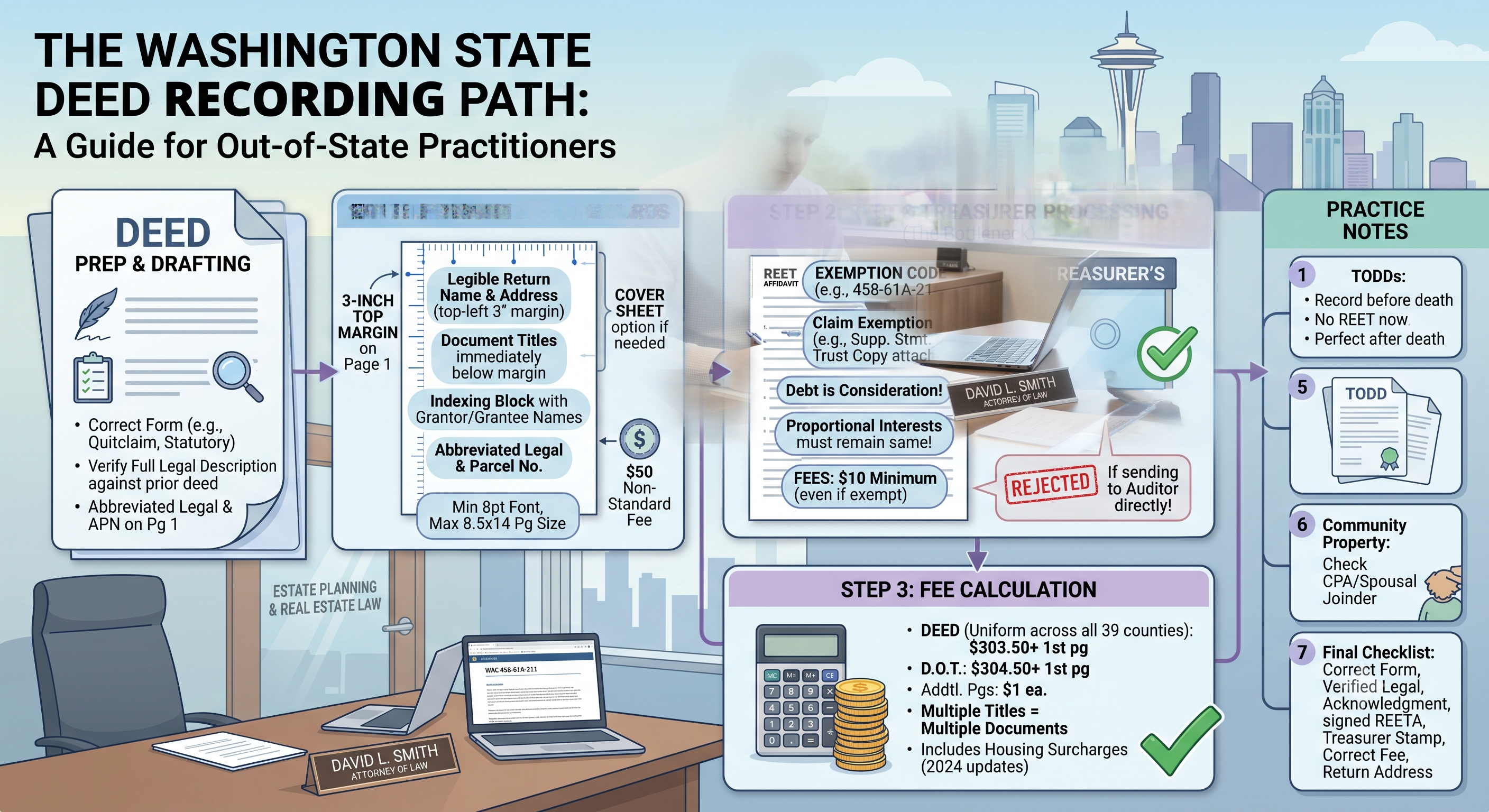
But the Auditor will not touch a conveyance until the County Treasurer has processed a Real Estate Excise Tax Affidavit ("REETA") and stamped the deed. This is true even when no tax is owed. A gift deed to a revocable living trust, a spousal transfer, a deed funding an irrevocable trust — all of them require an affidavit claiming an exemption, processed by the Treasurer, before recording.
Sending a Washington deed straight to the Auditor is the single most common reason an out-of-state package comes back unrecorded.
2. The REET affidavit and the exemptions you will actually use
The affidavit (DOR Form 84-0001A) must be signed by both grantor and grantee (or their agents), and must cite the correct WAC exemption code. The exemptions that recur in estate planning practice:
| Transaction | WAC cite | Supporting documents |
|---|---|---|
| Transfer to or from a revocable trust | 458-61A-211 | None |
| Transfer to or from an irrevocable trust | 458-61A-210 | Copy of the trust instrument |
| Gift (no consideration) | 458-61A-201 | REET Supplemental Statement (mandatory) |
| Inheritance / devise | 458-61A-202 | Certified death certificate plus Letters, court order, or recorded community property agreement |
| Creating or separating community property | 458-61A-203 | None |
| Mere change in identity or form (entity/trust reorganizations) | 458-61A-211 | Varies |
Two traps worth flagging to clients:
- Debt is consideration. A "gift" deed of encumbered property is taxable to the extent of the debt assumed. The Supplemental Statement exists precisely to make the preparer attest to this, and DOR audits it.
- Proportional interests must stay the same. Under WAC 458-61A-211, if the grantors' proportional interests shift after the transfer, the mere-change-in-form exemption fails and tax is due.
Even a fully exempt transfer costs money: a $5 state electronic technology fee applies to every transaction, plus a $5 affidavit processing fee where an exemption is claimed — a $10 minimum per affidavit.
3. Formatting standards (RCW 65.04.045 and .047)
Washington's first-page requirements are statutory, and the Auditor has no discretion to waive them:
- 3-inch top margin on page one; 1-inch bottom and side margins on page one and all sides of every other page. Margins must be blank — no stray marks, no writing.
- Return name and address in the upper left corner, within the 3-inch margin.
- Document title(s) immediately below the 3-inch margin, describing every transaction contained in the instrument.
- Reference number(s) of any prior recorded document the instrument affects.
- Grantor and grantee names, in the indexing block.
- Abbreviated legal description on page one, with the full legal description in the body (or an attached exhibit referenced on page one).
- Assessor's parcel / tax account number.
- Minimum 8-point font; page size no larger than 8½ x 14.
- No attachments affixed to the page other than firmly attached barcode or address labels. Taped or stapled notary blocks are rejected.
- No Social Security numbers, dates of birth, or a parent's maiden name may appear in the instrument.
If page one cannot carry all of that, RCW 65.04.047 lets the preparer attach a cover sheet containing the required indexing information; it records as part of the instrument and is billed as an additional page. A document that fails the margin or font standards can still be recorded as non-standard for an additional $50 — a useful escape hatch when a deadline is running, but not something to design around.
4. What it costs
Recording fees are set by statute (RCW 36.18 and 36.22) and are uniform across all 39 counties:
- $303.50 for the first page of a deed, $1.00 for each additional page
- $304.50 for the first page of a deed of trust
- $50 non-standard document fee, if applicable
- Multiple titles in one instrument are billed as multiple documents
That first-page figure includes a $183 housing affordability surcharge and a $100 Covenant Homeownership assessment added effective January 1, 2024. Set client expectations early — a Washington deed recording is not a $30 line item.
5. Transfer on death deeds
Washington adopted the Uniform Real Property Transfer on Death Act at chapter 64.80 RCW. A TODD must (1) contain the elements and formalities of a recordable inter vivos deed, (2) state that the transfer occurs at the transferor's death, and (3) be recorded before the transferor dies. An unrecorded TODD found in a client file after death is worthless.
Two practice notes:
- No REET affidavit is required to record the TODD itself, and no tax is due on recording.
- After death, the beneficiaries perfect title by recording a certified death certificate together with a signed affidavit claiming the inheritance exemption under WAC 458-61A-202, in the same county.
Beneficiaries also take subject to creditor claims and statutory allowances of the transferor's estate — a TODD moves the asset out of probate administration, not out of reach.
Washington does not recognize enhanced life estate ("Lady Bird") deeds. Where an out-of-state form calls for one, the TODD is the Washington analogue.
6. Community property is a live drafting issue
Washington is a community property state. A community property agreement under RCW 26.16.120 is recordable and is routinely used to vest survivorship without probate — but a CPA and a funding deed can produce contradictory results if drafted in isolation. Review both before recording anything, and confirm spousal joinder on any conveyance of community real property.
7. Pre-submission checklist
- Correct deed form (statutory warranty, bargain and sale, or quitclaim under RCW 64.04.030–.050)
- Full legal description verified against the last vested deed — not the tax statement
- Abbreviated legal and parcel number on page one
- Acknowledgment complete, notary commission unexpired, seal legible and not obscuring text
- REETA signed by all parties, correct WAC code, supplemental statement or trust copy attached
- Treasurer stamp obtained before submission to the Auditor
- Correct fee, including any non-standard surcharge
- Return address in the top-left of the 3-inch margin
Why attorneys choose 50deeds.com:
🔹 Only $299 per deed (for 40+ States) – a fraction of traditional costs
🔹 4-12 hour turnaround – get deed prepared in record time
🔹 Coverage in all 50 states – reliable service wherever your clients are
🔹 Complimentary prior deed search to confirm property ownership details before you proceed.
🔹 Complimentary Enterprise REST API for fully automated workflow.
Let us manage the paperwork while you focus on high‑value legal work. Ready to modernize your workflow? Visit 50deeds.com to learn more and get started today.