Recorded a Deed in the Wrong Massachusetts System? Why Registry of Deeds Recordings Don't Touch Registered Land

Marie Vagner
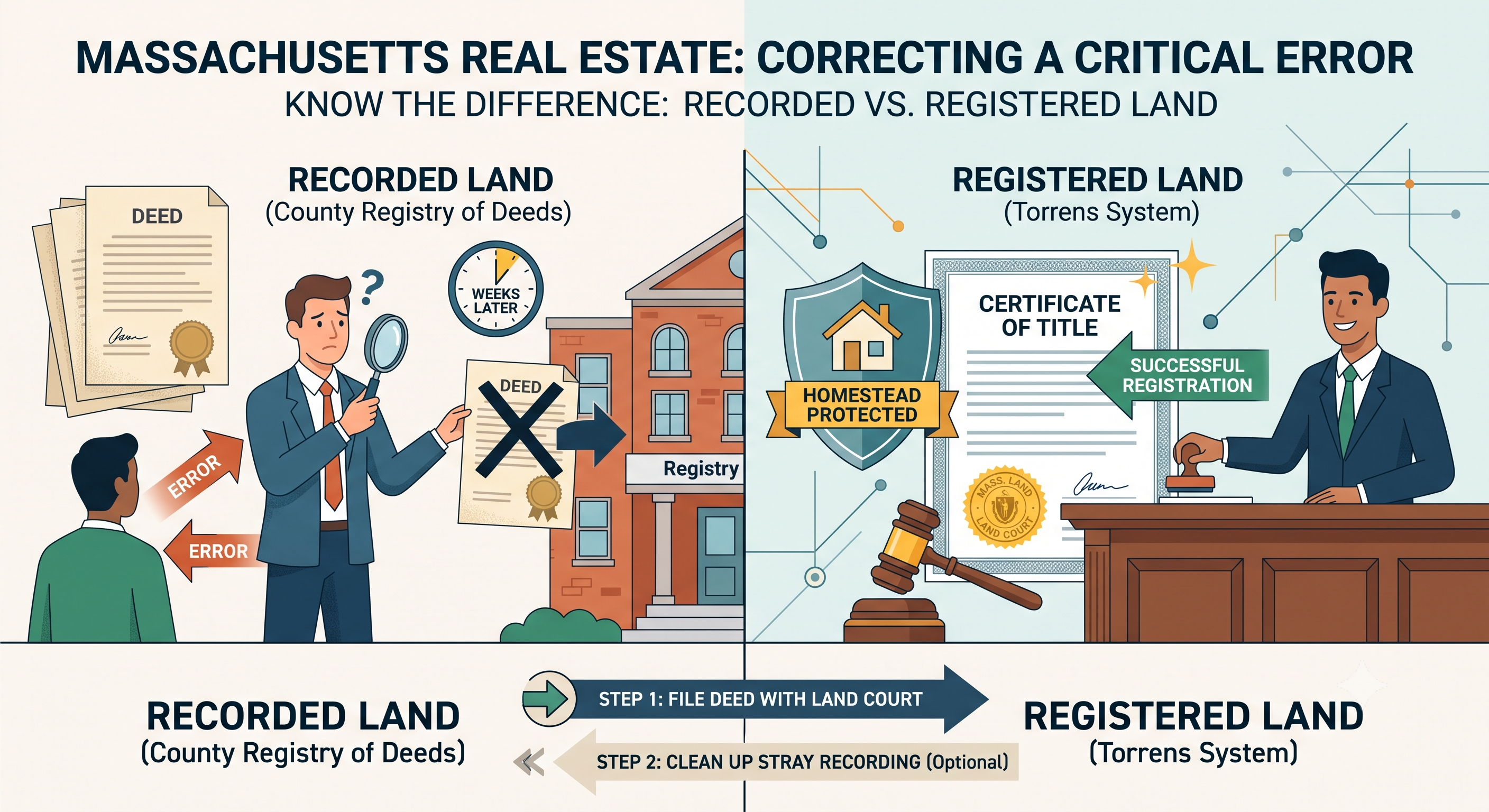
Massachusetts is one of a handful of states running two parallel real property systems side by side: recorded land, governed by the county Registries of Deeds, and registered (Torrens) land, governed by the Land Court. For estate planning attorneys funding trusts with Massachusetts real estate, confusing the two is one of the most common — and most misunderstood — recording errors we see.
Here's the scenario: a client's home is registered land. The deed transferring title into the client's revocable trust gets recorded at the Registry of Deeds. Weeks later, someone notices the certificate of title at the Land Court still shows the grantor as owner. What happened, and how do you fix it?
The recording had no effect on title
Under M.G.L. c. 185, § 57, a deed or other voluntary instrument purporting to convey registered land does not operate as a conveyance and does not bind the land. Until the instrument is filed with the Land Court's assistant recorder for the district where the land lies, it functions only as a contract between the parties and as authority for the recorder to register the transfer. Registration — not recording — is the operative act.
That means the erroneous Registry of Deeds recording accomplished nothing as to title. The grantor remained the record owner at the Land Court, and the trust acquired no interest through the misfiled deed. The Land Court reinforced this distinction in Wilmington Savings Fund Society, FSB v. Gray (Mass. Land Ct. 2020), where mortgage discharges recorded at the Registry of Deeds never cleared the encumbrances from the certificate of title because they were never filed with the Land Court. A certificate of title is a judicial decree, not a private instrument — only the Land Court can change it.
The fix is simpler than most attorneys expect
Step 1 — File the deed with the Land Court. Under M.G.L. c. 185, § 64, present the deed to the assistant recorder in the registry district where the property sits. The assistant recorder issues a new certificate of title to the trustee, cancels the prior certificate, and cross-references the transfer. This single filing is what actually conveys the property into the trust.
Step 2 — Clean up the stray recording (optional but smart). No statute requires cancelling the erroneous Registry of Deeds recording, because it never affected title. But a stray deed sitting in the recorded land index invites confusion in future title searches. A corrective affidavit or notation at the Registry clarifying that the property is registered land governed by the Land Court is inexpensive title hygiene. There's no need for a § 114 petition — that provision governs corrections to the Land Court's own registration book, not Registry records.
What about the homestead?
The related question we hear constantly: when an individual deeds their home into their own trust, does the homestead survive, and does a certificate of trust need to be filed with it?
The homestead survives. M.G.L. c. 188, § 10(a)(1) expressly provides that a deed to a trustee of a trust for the grantor's benefit does not terminate the grantor's existing homestead — it continues as to the grantor's interest as trust beneficiary. And since the 2010 amendments, the statutory definition of "owner" in c. 188, § 1 includes a natural person holding a present, vested, non-contingent beneficial interest in a trust.
Two mechanics matter when the home is held in trust:
- The trustee signs the homestead declaration, not the beneficiary individually (c. 188, § 5(a)(4)), and the declaration should identify the beneficiaries being protected.
- A declared homestead must be filed to get the $1,000,000 declared exemption; the automatic exemption is only $125,000. "Optional" applies to whether you file at all — not to whether filing works.
The certificate of trust, by contrast, is genuinely optional. It lives in the Massachusetts Uniform Trust Code (c. 203E, § 1013) as a privacy tool — something a trustee may furnish to third parties instead of the full trust instrument. Nothing in the Homestead Act or the registered land statute requires filing one alongside a homestead declaration, and the Land Court fee schedule doesn't even list a fee for it. A homestead declaration filed at the Land Court without a certificate of trust is valid.
Why attorneys choose 50deeds.com:
🔹 Only $299 per deed (for 40+ States) – a fraction of traditional costs
🔹 4-12 hour turnaround – get deed prepared in record time
🔹 Coverage in all 50 states – reliable service wherever your clients are
🔹 Complimentary prior deed search to confirm property ownership details before you proceed.
🔹 Complimentary Enterprise REST API for fully automated workflow.
Let us manage the paperwork while you focus on high‑value legal work. Ready to modernize your workflow? Visit 50deeds.com to learn more and get started today.