
Recording Deeds in Arizona: A Practical Guide for Estate Planning Attorneys

Marie Wolfgan
Arizona looks like an easy state to record in. There is no real estate transfer tax, the recording fee is a flat $30 regardless of page count, and there are only fifteen counties to learn. Out-of-state counsel relax — and then the package comes back from the counter unrecorded, because Arizona puts two of its hard requirements on the face of the document rather than in a separate submission form.
Here is what estate planning counsel needs to know before sending an Arizona deed to record.
1. No transfer tax — but the Affidavit of Property Value still gates recording
Arizona imposes no state or county real estate transfer tax; the state constitution has prohibited new ones since 2008. What it does impose is a filing requirement.
Under A.R.S. § 11-1133, the county recorder must refuse to record a deed or contract for sale unless a complete Affidavit of Property Value is appended — "unless the instrument bears a notation indicating an exemption."
That last clause is the whole game. In estate planning work you will almost never file the affidavit; you will claim an exemption. But the exemption has to be printed on the deed itself. A deed that is substantively exempt and silent about it is rejected exactly like one with no affidavit at all.
The standard notation looks like this:
This property transfers exempt from Affidavit and filing fee pursuant to A.R.S. § 11-1134(B)(8).
2. The exemptions you will actually use
Cite the subsection precisely. "Exempt under A.R.S. § 11-1134" is not a notation — the recorder is looking for the numbered paragraph.
| Transaction | A.R.S. cite | Note |
|---|---|---|
| Transfer to or from a trustee, nominal consideration | 11-1134(B)(8) | The workhorse cite for trust funding |
| Transfer pursuant to a beneficiary deed | 11-1134(B)(12) | Goes on the beneficiary deed itself |
| Family transfer — spouse, parent/child, grandparent/grandchild, sibling | 11-1134(B)(3) | Residential property only, nominal consideration |
| Creating community property with right of survivorship | 11-1134(B)(10) | Between spouses |
| Creating joint tenancy with right of survivorship | 11-1134(B)(11) | |
| To and from an intermediary to create a joint tenancy or other form of ownership | 11-1134(B)(9) | The straw-man transfer |
| Corrective deed confirming or correcting a prior recording | 11-1134(B)(2) | |
| Transfer due to a legal name change | 11-1134(B)(14) | |
| Deed of gift | 11-1134(A)(7) | Subsection A — see note below |
| Quitclaim to quiet title or for no monetary consideration | 11-1134(A)(4) | Subsection A — see note below |
The two subsections are not interchangeable. A transfer under subsection B is exempt from both the affidavit and the filing fee. A transfer under subsection A is exempt from the affidavit requirement itself. When a trust-funding deed could be characterized either as a gift under (A)(7) or as a transfer to a trustee under (B)(8), cite (B)(8) — it is the more precise fit and it carries the fee waiver.
3. The trap out-of-state counsel misses: A.R.S. § 33-404
This is the Arizona requirement that most reliably surprises practitioners who fund trusts in multiple states.
Every deed that names a grantee as trustee must disclose, on the instrument, the names and addresses of the beneficiaries for whom the grantee holds title, and must identify the trust agreement or reference where it appears in the public record. The same requirement runs the other way when a grantor conveys in a trustee capacity.
The consequence of omitting it is not theoretical. A conveyance that fails to comply is voidable by the other party for two years after recording. A purchaser who acquires the property for value is protected regardless — so the exposure sits with your client, not with a later buyer.
In practice this is one line:
Pursuant to A.R.S. § 33-404, the names and addresses of the beneficiaries under said trust are: [name], [address]; [name], [address].
Note the carve-outs in the statute's definition of "trustee" — it does not reach agents for a disclosed principal, conservators, guardians, personal representatives, attorneys-in-fact, deed of trust trustees, bankruptcy trustees, or business trust trustees. A deed to a personal representative does not need the disclosure. A deed to the trustee of a revocable living trust does.
4. Formatting standards (A.R.S. § 11-480)
Arizona's requirements are lighter than most western states', but the ones that exist are enforced at presentation:
- A caption briefly stating the nature of the instrument — "Quitclaim Deed," "Warranty Deed," "Beneficiary Deed." A deed with no caption is rejected at the counter. This is the most common Arizona rejection and the easiest to avoid.
- Original and legible, suitable for reproduction, bearing original signatures unless another law provides otherwise.
- Page size no larger than 8½ x 14, minimum 10-point type.
- A 2-inch top margin on the first page, reserved for recording information. The left 3.5 inches of that space may carry the requestor and return-address block.
- At least a half-inch margin top, bottom, left and right. Worth knowing: the statute expressly provides that failing the half-inch margin is not grounds for rejection, though it may affect the notice the recording gives. Failing the other requirements is grounds for rejection.
- Any instrument that modifies a previously recorded document must reference the original recording's date, docket and page.
One e-recording note that costs people a re-submission: keep the return-address block inside the left 3.5 inches. Run the header line wider than that and the recorder's electronic stamp lands on top of your own text in the reserved band.
Include the assessor's parcel number as well. It is not itself a rejection ground on the deed, but the Affidavit of Property Value requires it, and the county assessor uses it to map the transfer to the right parcel.
5. What it costs
Fees are set by A.R.S. § 11-475 and are uniform across all fifteen counties:
- $30 per instrument, flat — page count does not change it
- $15 per instrument where the United States, the state, or a political subdivision is a party and requests the recording
- $2 affidavit filing fee where an Affidavit of Property Value is actually filed — waived on § 11-1134(B) exemptions
- No state or county real estate transfer tax
Arizona is one of the least expensive states in the country to record in. Where budget pressure shows up on an Arizona file, it is almost always in the research and preparation, not the recording.
6. Beneficiary deeds — Arizona's answer to the Lady Bird deed
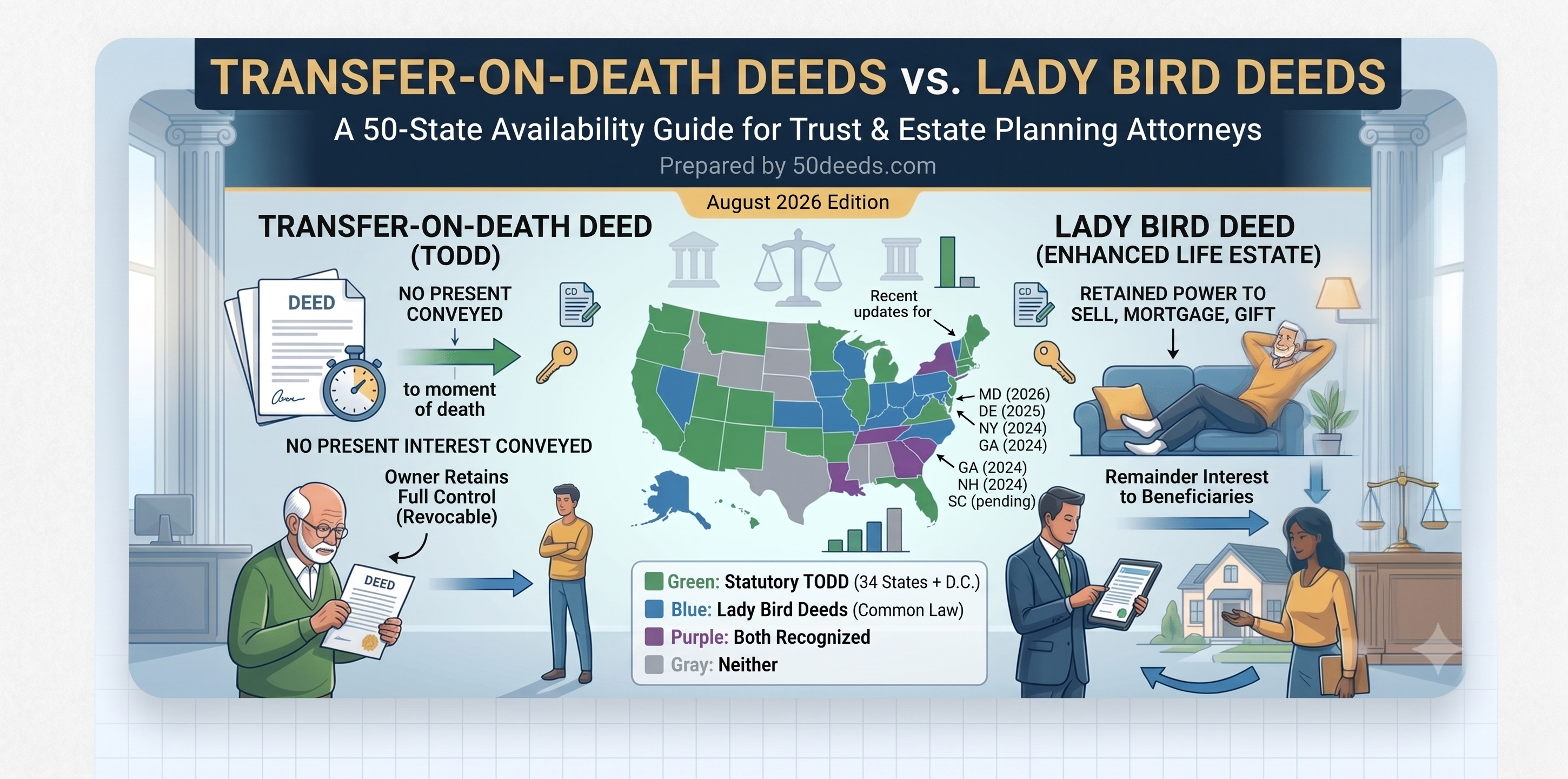
Arizona does not recognize enhanced life estate ("Lady Bird") deeds. Where an out-of-state form calls for one, the beneficiary deed under A.R.S. § 33-405 is the Arizona analogue.
To be valid, a beneficiary deed must convey the interest to a named grantee beneficiary, expressly state that it is effective on the death of the owner, and be executed and recorded in the county where the property sits before the owner — or the last surviving owner — dies. Recording is not a formality here. A signed beneficiary deed discovered in a client file after death conveys nothing.
Three points that decide most beneficiary deed questions in practice:
- Revocation must also be recorded before death. Where the property is held with survivorship rights, a revocation is not effective unless it is executed by the last surviving owner.
- Survivorship beats the beneficiary. If the property is held in joint tenancy with right of survivorship or as community property with right of survivorship, either all owners sign the beneficiary deed, or the last surviving owner must be among those who signed. Otherwise the surviving joint tenant or surviving spouse prevails over the grantee beneficiary — the beneficiary deed simply fails.
- The beneficiary takes subject to existing encumbrances. A beneficiary deed moves the asset out of probate administration. It does not move it out of reach of what is already recorded against it.
Note the § 11-1134(B)(12) exemption on the face of the beneficiary deed when you record it. After death, the grantee beneficiary clears title by recording a certified copy of the death certificate in the same county.
7. Vesting: community property and the express-words rule
Arizona is a community property state, and A.R.S. § 33-431 sets a default that catches people: a grant or devise to two or more persons creates an estate in common, not a joint tenancy, unless the instrument says otherwise — with an exception for grants to married persons.
Both survivorship forms require express words in the instrument:
- "as joint tenants with right of survivorship"
- "as an estate in community property with right of survivorship"
Either can be terminated by recording an affidavit terminating right of survivorship.
Two practical consequences at funding time:
Pull the vesting deed, not the tax roll. Older Arizona chains — Maricopa County especially — frequently pair a warranty deed with a separately recorded Acceptance of Joint Tenancy. The deed alone will not tell you how title is held. Reciting the wrong tenancy in a funding deed creates an ambiguity a title examiner will raise years later, usually at the worst possible moment.
Match the grantor names to the vesting deed exactly. Arizona recorders index by name. If title vests in "J. Raymond Johnson" and the trust instrument reads "Joseph Johnson," the funding deed has to carry both — "Joseph Raymond Johnson, also known as J. Raymond Johnson" — or the record shows a conveyance by a stranger to title. This is a five-word fix before recording and an affidavit-and-corrective-deed problem afterward.
8. Pre-submission checklist
- Caption on page one naming the instrument (§ 11-480)
- Exemption notation citing the specific § 11-1134 subsection — or a complete Affidavit of Property Value appended
- § 33-404 beneficiary names and addresses on any deed to or from a trustee
- Legal description verified against the last vested deed, not the tax statement
- Assessor's parcel number on the instrument
- Grantor names matching the vesting deed exactly, with a/k/a language where they differ from the trust
- Express survivorship language where the vesting calls for it (§ 33-431)
- 2-inch top margin clear on page one; return-address block within the left 3.5 inches
- 10-point minimum type; page no larger than 8½ x 14
- Acknowledgment complete, notary commission unexpired, seal legible and not obscuring text
- $30 recording fee
Why attorneys choose 50deeds.com:
🔹 Only $299 per deed (for 40+ States) – a fraction of traditional costs
🔹 4-12 hour turnaround – get deed prepared in record time
🔹 Coverage in all 50 states – reliable service wherever your clients are
🔹 Complimentary prior deed search to confirm property ownership details before you proceed.
🔹 Complimentary Enterprise REST API for fully automated workflow.
Let us manage the paperwork while you focus on high‑value legal work. Ready to modernize your workflow? Visit 50deeds.com to learn more and get started today.