Why California Homeowners Should Think Twice About Joint Tenancy — And Consider a Trust Instead

Marie Vagner
For decades, joint tenancy with rights of survivorship has been the default way many California couples hold title to their home. It's simple, it avoids probate when the first spouse dies, and it requires no special planning. But "simple" and "smart" aren't always the same thing — and in California, where property values have soared and capital gains taxes are among the highest in the nation, that default choice can quietly cost surviving spouses tens or even hundreds of thousands of dollars.
If you're a California estate planning attorney, your clients are almost certainly making this mistake. Here's why it matters, and why funding a revocable living trust is the cleaner, more tax-efficient solution.
The Hidden Tax Trap in Joint Tenancy
When a married couple owns appreciated property as joint tenants with rights of survivorship, the surviving spouse gets only a half step-up in cost basis when the first spouse dies. The deceased spouse's 50% interest is revalued to fair market value as of the date of death, but the surviving spouse's half retains its original purchase-price basis.
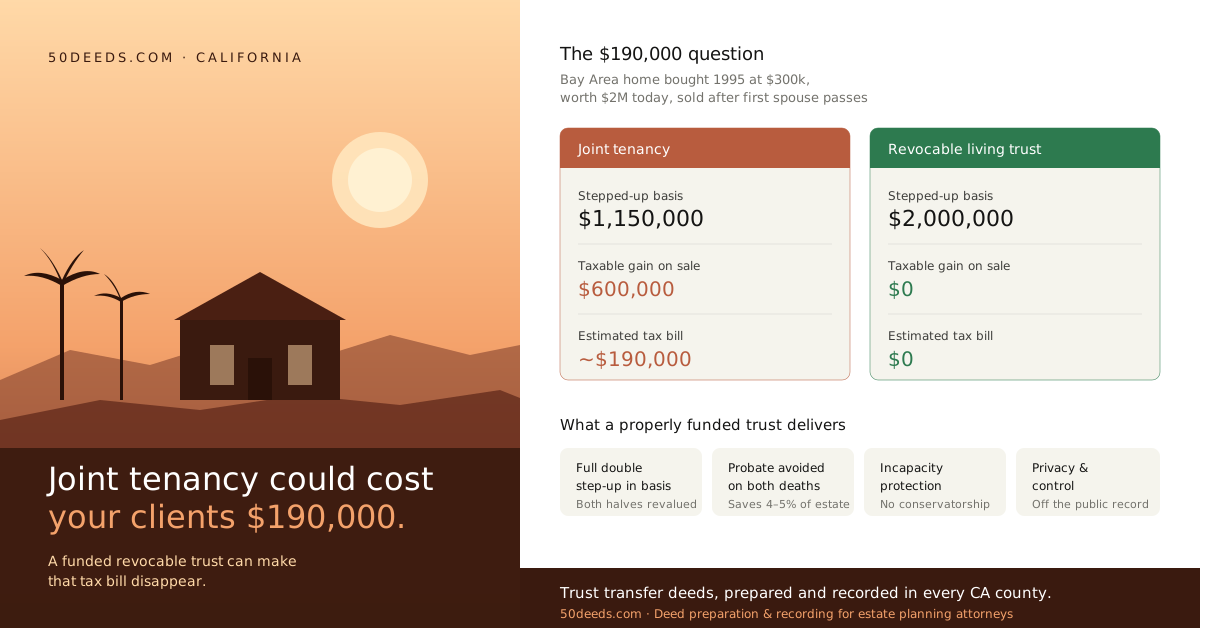
Consider a couple who bought a home in the Bay Area in 1995 for $300,000. Today it's worth $2 million. If they hold title as joint tenants and one spouse dies:
- The deceased spouse's half steps up from $150,000 to $1,000,000.
- The surviving spouse's half remains at its original $150,000 basis.
- Combined new basis: $1,150,000.
If the surviving spouse later sells for $2 million, roughly $850,000 in gain is potentially taxable (less the $250,000 single-filer exclusion). At California's combined state and federal capital gains rates — which can exceed 33% for higher earners — that's a tax bill north of $190,000. All of it avoidable.
California's Community Property Solution
California created community property with rights of survivorship specifically to fix this problem. When a married couple holds qualifying community property this way, the entire property — both halves — receives a full step-up in basis at the first spouse's death. Same scenario as above, but the surviving spouse's new basis is $2 million. Sell for $2 million, owe nothing in capital gains.
That's a powerful upgrade over plain joint tenancy. But it still leaves the property exposed to probate on the second death, offers no privacy, and provides no framework for incapacity planning, blended families, or staged distributions to children.
Why a Revocable Living Trust Is Usually the Better Answer
For most California couples with appreciated real estate, transferring the home into a properly drafted revocable living trust accomplishes everything community property with rights of survivorship does — and considerably more:
Full double step-up in basis. When community property is held in a joint revocable trust with appropriate community property language, both halves receive a stepped-up basis at the first spouse's death, just like community property with rights of survivorship.
Probate avoidance on both deaths. Joint tenancy and community property with rights of survivorship only avoid probate at the first death. When the surviving spouse passes, the property heads to probate unless further planning is done. A trust avoids probate on both deaths — a meaningful saving in California, where probate fees are statutorily set and can easily run 4–5% of gross estate value.
Incapacity protection. If a spouse becomes incapacitated, a successor trustee can manage and even sell the property without a court conservatorship. Joint tenancy offers no such protection.
Privacy. Probate is public. A trust administration is private.
Control over distribution. Trusts can protect assets for minor children, provide for beneficiaries with special needs, shield inheritances from divorcing spouses, and structure distributions over time — none of which joint tenancy or survivorship deeds can do.
Flexibility for blended families. Joint tenancy automatically gives everything to the surviving co-owner, which can unintentionally disinherit children from a prior marriage. A trust lets each spouse direct their share where they actually want it to go.
The Funding Gap Most Attorneys See Every Day
Here's the part that frustrates estate planning attorneys most: the client signs the trust, pays for the plan, walks out feeling protected — and the house is still titled in their individual names or as joint tenants. An unfunded trust controls nothing. The probate it was designed to avoid happens anyway.
Proper trust funding requires a new deed transferring the property from the individual owners into the trust, prepared with the right vesting language, executed with the right formalities, and recorded in the correct county. In California, that also means navigating Proposition 13 reassessment rules and the parent-child exclusion under Proposition 19, ensuring the transfer is structured to avoid triggering a property tax reassessment.
It's not complicated work, but it is detail-sensitive work — and it's the step that most often falls through the cracks between the attorney's office and the county recorder.
How 50deeds.com Helps California Estate Planning Attorneys
At 50deeds.com, we prepare and record trust transfer deeds for estate planning attorneys in all 58 California counties and across the country. We handle the deed drafting, the Preliminary Change of Ownership Report, the documentary transfer tax exemption analysis, and the recording — so your clients' trusts actually own what they're supposed to own.
For California attorneys, that means:
- Trust transfer deeds prepared with proper community property and survivorship language where appropriate
- PCOR completion with correct Proposition 19 / parent-child exclusion analysis
- Documentary transfer tax exemptions claimed correctly under Revenue & Taxation Code §11930
- Recording in the correct county, with confirmations sent back to your office
- Coverage across every California county, plus all 49 other states for clients with out-of-state property
You focus on the planning. We handle the deeds.