
Recording Deeds in Illinois: A Practical Guide for Estate Planning Attorneys

Marie Vagner
Illinois taxes a conveyance at up to three levels — state, county, and municipality — and the municipal layer can dwarf the other two. Chicago alone charges more than eight times the combined state and county rate. Before that, though, most estate planning transfers are exempt, and the mechanics of claiming the exemption are where Illinois packages fail.
Illinois also does something no other state in this series does: it runs a parallel ownership regime, the land trust, that changes what "recording a deed" even means. Here is what to check before recording in Illinois.
1. Three layers of transfer tax
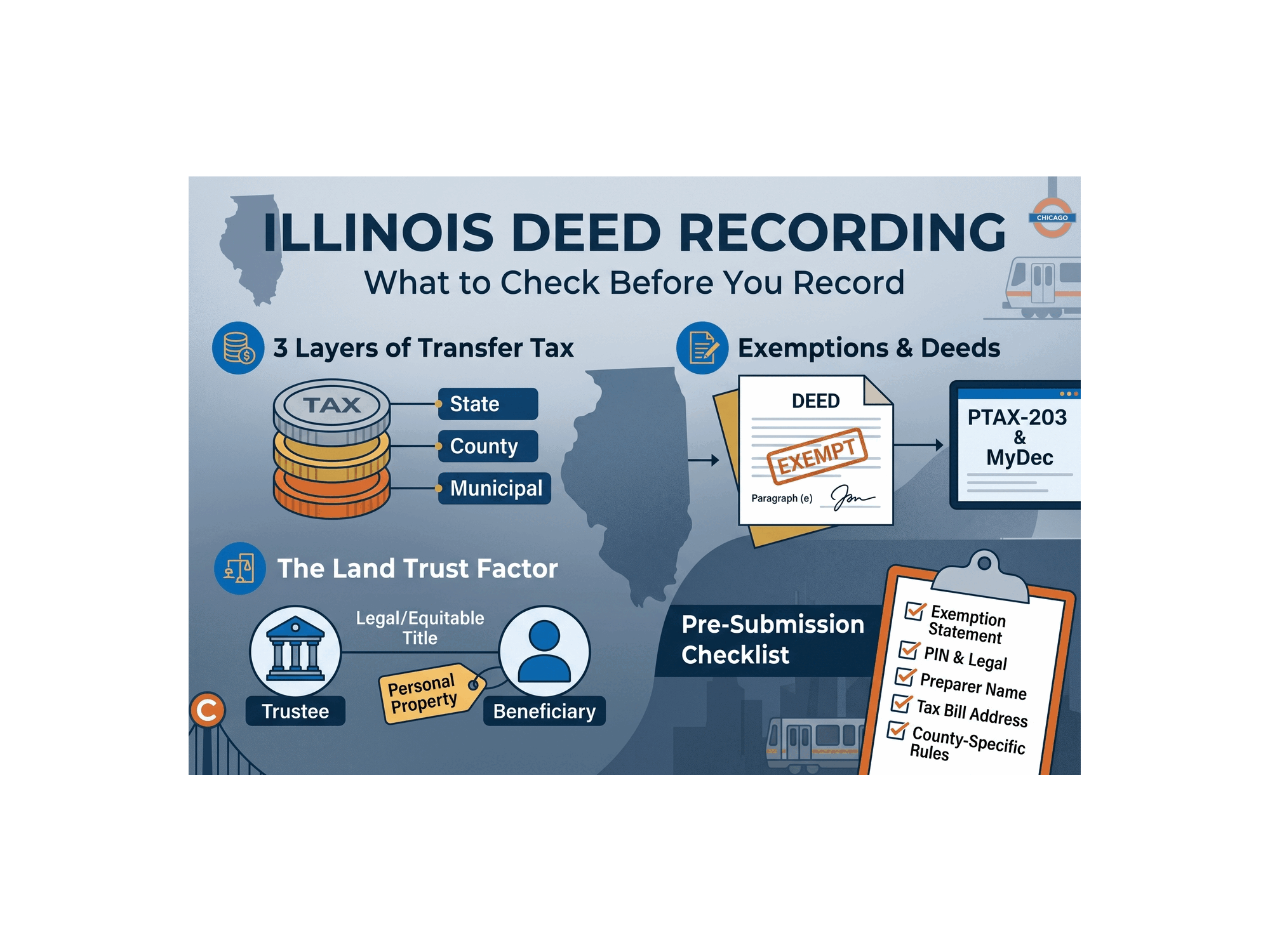
Illinois transfer tax stacks:
- State: $0.50 per $500 of value, or fraction thereof
- County: $0.25 per $500 of value, or fraction thereof
- Municipal: set locally and often much larger. Chicago charges $3.75 per $500 plus an additional $1.50 per $500 for the Chicago Transit Authority.
The seller generally bears the state and county tax, since the seller delivers the recordable deed. Municipal allocation varies by ordinance — in Chicago the buyer normally pays the city portion and the seller pays the CTA portion, with the city share shifting to the seller where the buyer holds a state or federal exemption.
The practical consequence for estate planning work: a transfer that is exempt at the state and county level is not automatically exempt municipally. Home rule municipalities set their own exemption lists and many require their own stamp or exemption approval before the county will record. Check the municipality separately, and check it early — some cities require a water certification or a zoning inspection before they will issue a transfer stamp, which can add weeks.
2. The exemption goes on the deed
Illinois requires the exemption to be stated on the face of the instrument, citing both the basis and the statutory authority. The standard Real Estate Transfer Tax Exemption Statement reads along these lines:
Exempt under provisions of Paragraph (e), Section 31-45, Real Estate Transfer Tax Law. [Date] [Signature]
For estate planning transfers, paragraph (e) is the one you will use most: "Deeds or trust documents where the actual consideration is less than $100." Trust funding, gift deeds, and transfers to a land trust nearly always sit here.
The full exemption list at 35 ILCS 200/31-45:
| Paragraph | Exemption |
|---|---|
| (e) | Actual consideration less than $100 — the estate planning workhorse |
| (d) | Deeds or trust documents confirming, correcting, modifying or supplementing a prior recording, without additional consideration |
| (b) | Transfers involving governmental bodies or charitable, religious and educational organizations |
| (c) | Deeds or trust documents securing a debt or other obligation |
| (g) | Documents releasing property securing a debt |
| (h) | Deeds of partition |
| (i) | Corporate reorganizations under the federal tax code or bankruptcy law |
| (j) | Subsidiary-to-parent transfers solely for cancellation of stock |
| (k) | Exchanges of real estate — any money difference paid remains taxable |
| (l) | Mortgage foreclosure deeds and deeds in lieu of foreclosure |
| (f) | Tax deeds |
Note that some exemptions still require a declaration to be filed even though no tax is due. Exempt does not always mean paperwork-free.
3. The transfer declaration — PTAX-203 and MyDec
A transfer declaration must be filed when the deed is presented for recording, or within three business days after the transfer, whichever is earlier. The paper form is PTAX-203; supplemental forms PTAX-203-A and PTAX-203-B apply to non-residential transfers above threshold amounts and to beneficial interest transfers.
Most Illinois counties now require electronic filing through MyDec, the Illinois Department of Revenue's online declaration system, rather than accepting the paper form. Cook County has required it for years. Because adoption has rolled out county by county, confirm the filing method with the specific county recorder before assembling the package — a paper PTAX-203 sent to a MyDec county is simply returned.
Deeds exempt under paragraph (e) generally do not require a full declaration, but they do require the exemption statement on the deed, and many counties require the deed to be presented for an exemption stamp regardless.
4. What else has to appear on an Illinois deed
- Name and address of the preparer — "This instrument was prepared by …"
- Name and address for future tax bills — "Send subsequent tax bills to …" This is separate from the return address and both should appear.
- Permanent Index Number (PIN) for the parcel, and the common street address
- Full legal description, verified against the last vested deed rather than the tax bill
- The Plat Act affidavit where the conveyance describes a portion of a larger parcel, confirming the transfer falls within an exemption to the Plat Act (765 ILCS 205/1)
Illinois recording standards also govern the physical document — margin, paper size and legibility requirements are set by statute and enforced by the recorder, with a non-standard document fee where a deed falls outside them. Confirm the county's current standards; several Illinois counties charge a substantial predictable-format surcharge.
5. Land trusts change the analysis
Illinois is the land trust state, and this is the section out-of-state counsel most need.
Where title is held in an Illinois land trust, the trustee holds both legal and equitable title, and the beneficiary's interest is personal property, not real property. That single fact reorders several things:
- Funding a living trust may not require a deed at all. If the residence is already in a land trust, the transfer is an assignment of beneficial interest, not a conveyance — and an assignment of beneficial interest is not recorded with the recorder of deeds.
- A transfer of beneficial interest can still be taxable. Illinois taxes transfers of a beneficial interest in a land trust as well as deeds. Do not assume that avoiding the recorder avoids the tax.
- The chain of title looks wrong until you know to expect it. A search shows the land trustee as owner, with nothing on record about who actually controls the property. Ask the client whether a land trust exists before ordering a deed — a funding deed drafted against the record owner will be the wrong instrument entirely.
Cook County's Torrens registered land system was abolished and fully deregistered, so registered-land questions no longer arise in Illinois the way they do in Massachusetts. Older title work that references a Torrens certificate is historical.
6. Transfer on death instruments
Illinois recognizes the transfer on death instrument, and its scope was expanded beyond residential real estate by amendment. Illinois does not use enhanced life estate ("Lady Bird") deeds; the TODI is the Illinois analogue.
Core requirements track the pattern in other TOD states, with the usual decisive one: the instrument must be executed and recorded during the owner's lifetime, in the county where the property sits. Revocation must likewise be recorded before death. An unrecorded TODI conveys nothing.
Two planning notes. A TODI moves the asset out of probate administration but not out of reach of the owner's creditors or of Illinois estate recovery. And where property is held with survivorship rights, survivorship generally prevails over the TODI beneficiary — confirm how title is actually held before recommending one.
7. Pre-submission checklist
- Confirm whether a land trust holds title before drafting anything
- Real Estate Transfer Tax Exemption Statement on the face of the deed, citing paragraph and section (usually paragraph (e) of § 31-45)
- Transfer declaration filed by the method the county actually accepts — MyDec or paper PTAX-203
- Municipal transfer tax and stamp requirements checked separately from state and county, including any water certification or inspection prerequisite
- Preparer name and address on the instrument
- "Send subsequent tax bills to" name and address
- Permanent Index Number and common address
- Plat Act affidavit where the deed conveys part of a larger parcel
- Legal description verified against the last vested deed
- Grantor names matching the vesting deed exactly, with a/k/a language where they differ from the trust
- Acknowledgment complete, notary commission unexpired, seal legible
- County recording fee confirmed, including any non-standard document surcharge
Why attorneys choose 50deeds.com:
🔹 Only $299 per deed (for 40+ States) – a fraction of traditional costs
🔹 4-12 hour turnaround – get deed prepared in record time
🔹 Coverage in all 50 states – reliable service wherever your clients are
🔹 Complimentary prior deed search to confirm property ownership details before you proceed.
🔹 Complimentary Enterprise REST API for fully automated workflow.
Let us manage the paperwork while you focus on high‑value legal work. Ready to modernize your workflow? Visit 50deeds.com to learn more and get started today.