
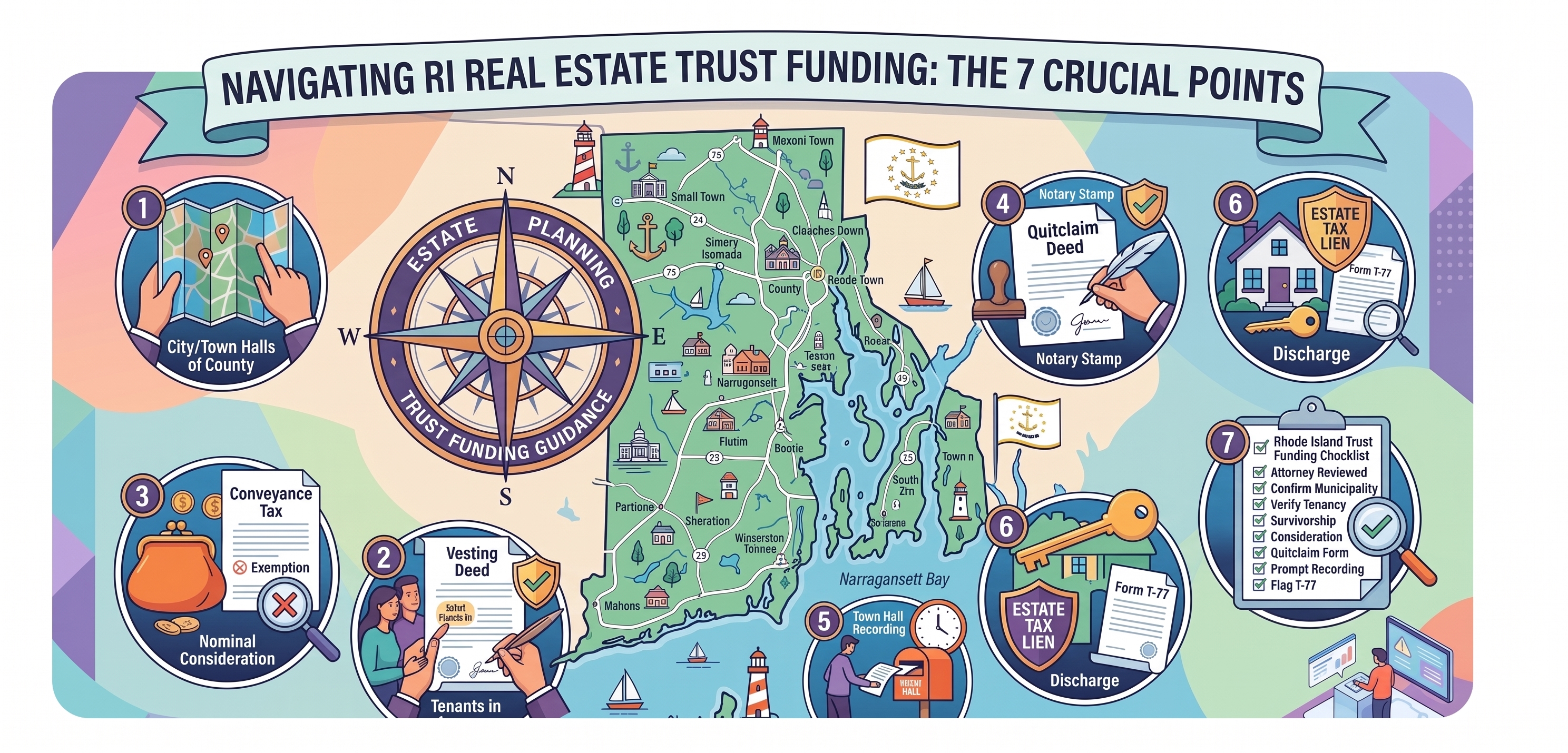

Funding a Revocable Trust with Rhode Island Real Estate: 7 Traps for Estate Planning Attorneys

Marie Vagner
Rhode Island is small, but it doesn't forgive mistakes. This guide covers the seven points that matter most when you move Rhode Island real estate into a revocable living trust.
1. Record with the city or town, not a county
Rhode Island has no county-level recording system. Deeds are recorded in the Land Evidence Records of the city or town where the property sits, and there are 39 of them. Each municipal clerk sets its own intake practices, e-recording availability and turnaround. A deed sent to the wrong town isn't recorded, and it may sit for weeks before anyone tells you.
Practice point: confirm the municipality from the vesting deed and the tax assessor's records, not from the mailing address. Village names and ZIP codes often cross town lines.
2. Pull the vesting deed and read the tenancy language
Under R.I. Gen. Laws § 34-3-1, a conveyance to two or more people creates a tenancy in common unless the deed expressly creates a joint tenancy. That default applies to spouses too. Many Rhode Island couples assume they hold title "jointly" when their deed actually vests them as tenants in common.
This matters for trust funding in two ways:
- Living co-owners: every record owner must sign the deed into the trust. If one co-owner signs alone, only that owner's undivided interest is conveyed.
- A deceased co-owner: if one owner has died, check the vesting deed for survivorship language before you prepare anything. With survivorship words, the survivor can clear title by recording an affidavit of survivorship with a certified death certificate and then fund the trust. Without them, the decedent's share is a probate asset, and a deed from the survivor alone won't carry it.
3. There is no trust exemption from conveyance tax
Rhode Island's realty conveyance tax (R.I. Gen. Laws § 44-25-1) rose to $3.75 per $500 of consideration for transfers on or after October 1, 2025. A second tier adds another $3.75 per $500 on the part of a residential sale price above an inflation-indexed threshold, which is $824,000 for 2026. The seller pays unless the parties agree otherwise.
Many states list transfers to a revocable trust as an express exemption. Rhode Island's exemption list in § 44-25-2 has no such entry. What keeps a trust-funding deed tax-free is that the tax applies only where the consideration paid exceeds $100. A transfer into the grantor's own revocable trust for nominal consideration falls under that floor.
Practice point: recite nominal consideration that is actually paid (or none), and don't recite fair market value. A deed that recites market value invites the clerk to collect tax on it.
4. A Rhode Island quitclaim deed still carries a warranty
Out-of-state practitioners often pick a quitclaim deed for trust funding because they read it as a no-warranty instrument. In Rhode Island, the statutory quitclaim form (R.I. Gen. Laws § 34-11-12) carries statutory "quitclaim covenants." Those are a limited warranty against claims arising by, through or under the grantor. For a transfer into the grantor's own trust that is usually harmless, and it helps preserve title insurance continuity. But the drafting should be deliberate, not borrowed from another state's form.
Execution is simple: Rhode Island requires no witnesses. The grantor's signature must be acknowledged before a notary, and under the state's notary law (R.I. Gen. Laws ch. 42-30.1) the notary's stamp must appear on the acknowledgment.
5. Record promptly; the spousal life estate depends on it
Under R.I. Gen. Laws § 33-25-2(b), a surviving spouse takes a life estate in the decedent's real estate. A lifetime conveyance defeats that life estate only if the deed was recorded before the grantor's death. A deed signed at the plan-signing meeting and kept in the client binder "to record later" won't protect the trust if the client dies first.
Practice point: treat recording as part of the signing, not a follow-up task. Get the deed to the town clerk the same week it's signed, and don't let clients hold original signed Rhode Island deeds.
6. Funding the trust doesn't avoid the estate tax lien
Rhode Island still has a state estate tax, with a filing threshold indexed each year ($1,838,056 for deaths on or after January 1, 2026). Under R.I. Gen. Laws § 44-23-12, a statutory estate tax lien attaches to a decedent's real property. That lien doesn't go away because the property was held in a revocable trust or passed by survivorship. When the successor trustee later sells or distributes the property, the title company will require a Discharge of Estate Tax Lien (Form T-77) from the Division of Taxation. The form is filed one property at a time, in triplicate, using the tax assessor's description as of the date of death.
Practice point: build the T-77 into your trust administration checklist for any client with Rhode Island real estate, even when no estate tax is due.
Rhode Island trust funding checklist
- Deed drafted or reviewed by a licensed attorney
- Municipality confirmed from the vesting deed and the assessor's records
- Vesting deed reviewed for tenancy; all record owners signing
- Survivorship affidavit or probate resolved first if a co-owner has died
- Consideration recited to fall under the $100 conveyance tax floor
- Statutory quitclaim form used, with the notary stamp on the acknowledgment
- Deed sent for recording immediately after signing
- Form T-77 flagged in the client's trust administration file
Why attorneys choose 50deeds.com:
🔹 Only $299 per deed (for 40+ States) – a fraction of traditional costs
🔹 4-12 hour turnaround – get deed prepared in record time
🔹 Coverage in all 50 states – reliable service wherever your clients are
🔹 Complimentary prior deed search to confirm property ownership details before you proceed.
🔹 Complimentary Enterprise REST API for fully automated workflow.
Let us manage the paperwork while you focus on high‑value legal work. Ready to modernize your workflow? Visit 50deeds.com to learn more and get started today.
This article is general information for legal professionals and is not legal advice. Statutory thresholds and rates change; confirm current figures with the Rhode Island Division of Taxation and the recording municipality before relying on them.