Clearing Title After the Death of a California Joint Tenant: The Affidavit of Death of Joint Tenant

Marie Vagner
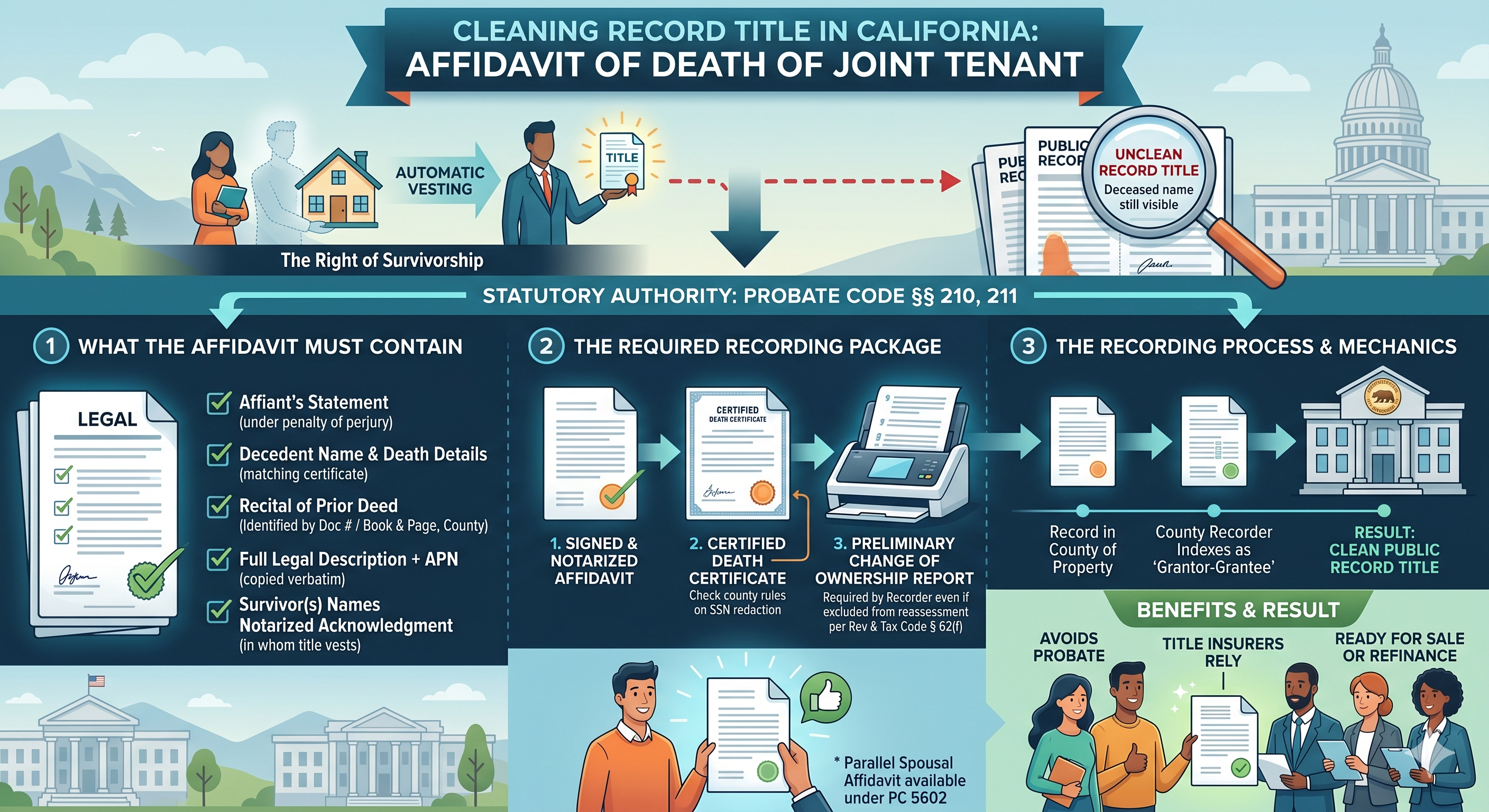
One of the principal advantages of holding California real property in joint tenancy is the right of survivorship — when one joint tenant dies, title vests automatically in the surviving joint tenants by operation of law, without probate. Nothing technically "passes" from the deceased joint tenant to the survivor; the survivor takes from the original instrument that created the joint tenancy.
But automatic vesting is not the same as clean record title. Until the county land records reflect the death, the deceased joint tenant remains a named owner on the public record, and no buyer, lender, or title insurer will treat the surviving tenant as the sole owner. The standard cure is an Affidavit of Death of Joint Tenant, recorded under California Probate Code §§ 210 and 211.
Statutory authority
Probate Code § 210 provides that if title to real property is affected by the death of a person, any person may record in the county where the property is located certain documents establishing the fact of death — including an affidavit. The affidavit must include a particular description of the real property and an attested or certified copy of a death record made and filed in a designated public office.
Once recorded, the county recorder indexes the affidavit in the grantor-grantee index, with the deceased joint tenant indexed as the grantor and the surviving joint tenants as the grantees. Title insurers and third parties (including potential buyers) can then rely on the recorded affidavit as evidence of who owns the property.
A parallel statutory affidavit exists for surviving spouses who held property as joint tenants under Probate Code § 5602, which is functionally similar but recites the spousal relationship.
What the affidavit must contain
A properly drafted Affidavit of Death of Joint Tenant should include:
- The affiant's identification and statement made under penalty of perjury under California law.
- The full legal name of the decedent and the date and place of death, matching the death certificate.
- A recital that the decedent is the same person named as a joint tenant in the prior recorded deed, identified by document number or book and page, recording date, and county.
- The complete legal description of the property — copied verbatim from the vesting deed, not the street address alone. The Assessor's Parcel Number should also be included.
- The surviving joint tenant(s) identified as the persons in whom title now vests by right of survivorship.
- Notarized acknowledgment.
A certified copy of the death certificate must be attached. Most California counties will record the death certificate as part of the affidavit; a few require a redacted version because of social security number visibility under Health & Safety Code § 103526 — confirm with the specific county recorder.
Recording mechanics
The affidavit is recorded in the county where the real property is located. Required at recording:
- The signed and notarized affidavit;
- A certified death certificate;
- A Preliminary Change of Ownership Report (PCOR), which the recorder generally requires even though the death of a joint tenant is excluded from reassessment under Revenue and Taxation Code § 62(f). Without the PCOR, the recorder will charge an additional $20 fee and the assessor will follow up with a Change in Ownership Statement.
The Affidavit of Death of Joint Tenant is a small document with outsized consequences. Done right, it perfects record title in a single recording and avoids probate entirely. Done wrong — defective legal description, missing PCOR, overlooked BOE-19-P — it creates a title cloud that surfaces years later when the surviving owner tries to sell or refinance
At 50deeds.com, we handle the deed work so you can focus on your clients. Our Deed Transfer Service is built for trust and estate practices that want speed, accuracy, and predictable costs.
Why attorneys choose 50deeds.com:
🔹 Only $299 per deed (for 40+ States) – a fraction of traditional costs
🔹 4-12 hour turnaround – get deed prepared in record time
🔹 Coverage in all 50 states – reliable service wherever your clients are
🔹 Complimentary prior deed search to confirm property ownership details before you proceed.
🔹 Complimentary Enterprise REST API for fully automated workflow.
Let us manage the paperwork while you focus on high‑value legal work. Ready to modernize your workflow? Visit 50deeds.com to learn more and get started today.